Border Collie Puppy Training Timeline: 8 Weeks to 2 Years

General training information. Every dog is an individual; for health or behavior concerns, see your veterinarian.
A Border Collie puppy is smart, quick and always watching you. That is the good news. The hard part is that the same brain will invent its own jobs if you do not provide any, and some of those jobs involve your ankles, the cat and the neighbor's kids.
This guide walks through border collie puppy training from the day you bring the puppy home to about age two. It covers house training, socialization, bite inhibition, the awkward teenage months and the slow road to maturity. Treat the ages as signposts, not deadlines. Individual dogs vary, and a puppy that is ahead in one skill may be behind in another.
If you want the full foundation of methods before you start, read our complete guide to training a Border Collie. This page is the calendar that goes with it.
 "
+ "
Table of contents
- Key Takeaways
- 8 to 12 Weeks: Settling In
- 3 to 7 Months: The Socialization Window and Foundations
- 7 to 12 Months: Adolescence
- 12 to 24 Months: The Road to Maturity
- Border Collie Puppy Training Schedule at a Glance
- Health and Exercise Checkpoints
- Sources
Key Takeaways
- The American Kennel Club (AKC) rates the Border Collie 5 of 5 for energy, mental stimulation needs and trainability. A puppy needs both exercise and a job.
- The AKC says early socialization is especially vital, from early puppyhood through about seven months. Plan outings with that window in mind.
- Obedience training should start early and continue for life, according to the AKC, because it also feeds the dog's mind.
- The AKC notes the breed tends to herd animals and people. Teach bite inhibition and calm manners early, and supervise time with children.
- The Border Collie Society of America (BCSA) Health Statement says growth plates close at about 12 months and that hips are evaluated after 24 months. Ask your veterinarian how to pace hard exercise in between.
- Use reward-based methods only, in line with the American Veterinary Society of Animal Behavior (AVSAB).
8 to 12 Weeks: Settling In
Your first month with a new puppy is about routine, safety and building a good relationship. You are not building a finished obedience dog yet. You are teaching the puppy that humans are fun, predictable and worth watching.
House training
House training is mostly management. Take the puppy out often, especially after sleeping, eating, playing and drinking. Go to the same spot, wait quietly, and reward with a treat and calm praise right after the puppy finishes, not when you are back inside.
When you cannot watch the puppy, use a crate, a pen or a gated room. Accidents are information about your schedule, not a character flaw. Never punish an accident. Clean it with an enzymatic cleaner and tighten your supervision.
Crate and alone time
Make the crate a pleasant place with chews and meals. Start with very short stays while you are in the room, then build up slowly. The AKC says this breed can be too much dog for owners who lack the time or energy to keep it occupied, so teaching calm alone time now pays off later.
Name, attention and handling
Begin with easy games. Say the puppy's name, then reward the glance. Reward every time the puppy checks in with you. This eye contact habit is the base for nearly everything else.
Also practice gentle handling. Touch paws, ears and collar, give a treat, and stop before the puppy is stressed. Your veterinarian and groomer will thank you.
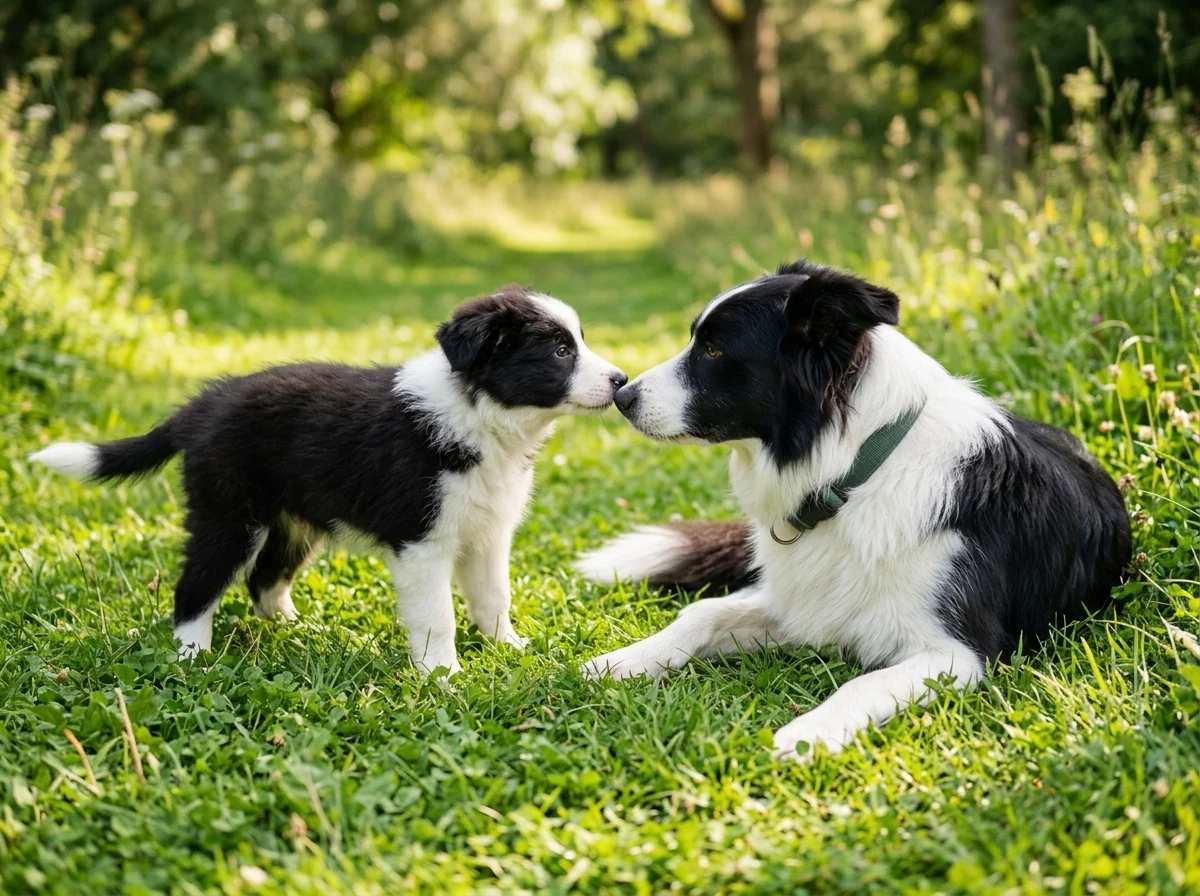
Bite inhibition begins
All puppies mouth. Border Collie puppies can add nipping at heels and clothing, which fits the breed's herding background. The BCSA breed standard describes the breed as a stock dog that controls sheep with eye and a stalking movement, so a puppy that stalks and nips is behaving like its ancestors, not like a bad dog.
Here is a simple, humane approach:
- When teeth touch skin, say nothing dramatic. Calmly stop play for a few seconds.
- Offer a toy or chew instead, and praise when the puppy takes it.
- If the puppy is overtired and frantic, that is a nap problem. Move to the crate or pen for a rest.
- Never hold the mouth shut, scruff or roll the puppy. These methods do not fit AVSAB guidance and can damage trust.
 "
+ "
3 to 7 Months: The Socialization Window and Foundations
The AKC emphasizes early socialization from early puppyhood through about seven months for this breed. That does not mean cramming in as many people as possible. It means safe, calm, positive exposure to the world while the puppy is still open to it.
What good socialization looks like
Aim for variety at the puppy's own pace. Think of different surfaces, sounds, vehicles, hats, umbrellas, friendly adults and calm, vaccinated, well-mannered dogs. Ask your veterinarian which places are safe for your puppy's vaccination stage before you go out.
Both the AKC breed page and the BCSA breed standard say the breed may be reserved with strangers, though a dog should never be shy or fearful. Reward your puppy for looking at new people and then looking back at you. Do not force greetings. Let the puppy approach, and end sessions on a good note.
Watch also for motion sensitivity. A breed built to watch and respond to moving stock can fixate on bikes, skateboards and cars. Reward your puppy for noticing a moving thing and turning away. Start at a distance where the puppy can still eat a treat.
Foundation skills
This is the stage for short, upbeat lessons. Several two to five minute sessions beat one long drill. Teach these skills:
- Sit, down and stand: use a treat lure, then fade it into a hand signal.
- Recall: say the cue only when you are sure the puppy will come, and make arriving the best thing in the puppy's day.
- Settle on a mat: reward calm behavior on purpose. A dog with an AKC energy rating of 5 will not learn it by accident.
- Leave it and drop it: trade for something better rather than grabbing.
- Loose leash walking: stop when the leash tightens, and reward when it loosens.
The AKC calls the breed a superstar at herding, obedience and agility. Your puppy will probably learn quickly. The risk is not slow learning. It is teaching accidental habits, such as barking for attention, because the puppy picks those up just as fast. The AKC rates barking level 4 of 5, so reward quiet moments early.
Herding behavior at home
The AKC says the breed tends to herd animals and people and does best with older, well-behaved children. Never leave a puppy unsupervised with young kids. Teach children to stand still and calm, not run and squeal, and redirect your puppy to a toy or a trained behavior such as sit.
 "
+ "
7 to 12 Months: Adolescence
Around the time the socialization window winds down, many puppies hit the teenage phase. You may see selective hearing, a recall that suddenly fails, new fears and a puppy that seems to have forgotten everything you taught. This is normal development, not proof that you ruined the dog.
What to do
- Go back to basics. Practice skills in easy places, then add distractions slowly.
- Raise your rewards. Use better treats and play when the environment gets harder.
- Use a long line for recall practice in open areas instead of trusting an off-leash dog too soon.
- Keep socializing gently. Do not assume the job is finished at seven months. Keep up positive experiences with new people, places and dogs.
- Watch for fear periods. If your puppy suddenly seems worried by something familiar, give space and rewards, and never force closeness.
Give the brain a job
The AKC says this breed needs a job or activity to be happy, and lists agility, herding and obedience as outlets. The AKC also lists rally, tracking, flying disc and flyball among the breed's sports. Many clubs offer foundation classes for young dogs. Check with the club or facility about minimum ages and how they protect growing joints before you enroll.
Not every owner wants to compete. Daily training games, food puzzles, scent games and learning new tricks all count. A bored Border Collie often makes up its own entertainment, and you will probably not like the choice.
Pace the exercise
The AKC says the breed needs daily exercise beyond a walk or yard romp, plus space to run. Puppies still need rest, though. The BCSA Health Statement says growth plates close at about 12 months. Ask your veterinarian what level of jumping, hard stops, stairs and repeated sprinting is suitable for your puppy's age and build. Choose varied activity over endless repetition of one hard impact exercise.
The University of Minnesota Canine Genetics Lab describes Border Collie Collapse as an episodic disorder triggered by strenuous exercise. It advises watching for collapse during strenuous play such as repeated ball retrieving, and stopping at the first sign of wobbliness. Ball-obsessed and sport dogs are the ones to watch. Vary the games, end them while the dog still wants more, and call your veterinarian if you see this.
Spay and neuter timing
The BCSA Health Statement recommends spay or neuter no earlier than 12 months. This is the club's position, not a consensus among all veterinarians. Talk it through with your own veterinarian, who knows your dog's health and your household.
" + "12 to 24 Months: The Road to Maturity
By the first birthday your dog looks like an adult, but the brain is still catching up. Expect the second year to bring steadier focus, better impulse control and more reliable skills if you keep practicing. Some dogs settle sooner and some take longer.
Proof your skills
Now is the time to generalize. Practice sit, down, stay and recall in more places: parks, pet-friendly stores where allowed, quiet streets and around other dogs at a comfortable distance. Increase the length of stays and the distance from you gradually. Keep rewarding, even once the dog knows the cue. Reward-based training does not stop working when the puppy grows up.
Start more advanced work
The BCSA standard says the breed was selected for biddable stock sense and can work out of sight of the handler without commands. In plain words, this is a dog bred to think on its own. Channel that with games that ask for choices, such as scent work, trick training, agility foundations or herding lessons with a qualified instructor. The BCSA Versatility program lists herding, obedience, rally, agility, conformation, scent work, barn hunt, Fast CAT and dock diving, which shows how many options exist.
If you are curious about working lines, the American Border Collie Association (ABCA) runs a working-dog registry, and the United States Border Collie Handlers Association (USBCHA) holds sheepdog and cattledog trials with annual National Finals. Both are good places to see what the breed was built for.
Adult manners that still need work
- Calm in the house: keep rewarding the mat and settling.
- Reactivity: if your dog barks, lunges or stares at passing cars, bikes or dogs, get help from a qualified reward-based trainer or a veterinary behaviorist. Do not use aversive tools.
- Other dogs: the AKC rates the breed 3 of 5 with other dogs, meaning supervision. Not every dog needs to be a dog park dog.
Two years: what changes
Age two is a good planning marker because the BCSA says hips should be evaluated after 24 months. The Orthopedic Foundation for Animals (OFA) Canine Health Information Center (CHIC) program lists hip evaluation as a core Border Collie screen, either OFA radiographs or PennHIP. It also lists annual eye exams by a veterinary ophthalmologist until age seven, and participation in the DNA repository. Ask your breeder what they have done, and ask your veterinarian what is right for your dog.
The AKC gives a life expectancy of 12 to 15 years. A two-year-old has years of training ahead, and the AKC recommends obedience training that lasts a lifetime.
" + "Border Collie Puppy Training Schedule at a Glance
Use this border collie puppy training schedule as a starting point. Adjust it to your puppy and your veterinarian's advice.
| Age | Main focus | Daily practice ideas |
|---|---|---|
| 8 to 12 weeks | Routine, house training, handling, gentle bite inhibition | Frequent potty trips, crate rests, name game, short hands-on sessions, chew toys |
| 3 to 7 months | Socialization window, foundation cues, recall | Calm outings, mat settling, sit and down, leash basics, trading games |
| 7 to 12 months | Adolescence, impulse control, pacing exercise | Review basics, long line recall, puzzle feeders, foundation classes, varied low-impact play |
| 12 to 18 months | Generalizing skills, longer stays, new activities | Training in new places, scent games, agility foundations, tricks |
| 18 to 24 months | Maturity, reliability, sports or jobs | Proofing around distractions, regular classes or club activities, planned health screens |
These are border collie puppy training tips in table form. Keep sessions short, end on a win, and mix training with real-life rewards such as a sniff walk, a game of tug or a chance to greet a friend.
" + "Health and Exercise Checkpoints
Training and health overlap in this breed. A puppy who hurts, or one who is overworked, will not learn well. Use this list to talk with your veterinarian and breeder. We do not diagnose dogs or suggest medication or supplement doses. Those questions belong with your veterinarian.
- Before 12 weeks: the ABCA Health and Genetics Committee recommends eye exams for Collie Eye Anomaly (CEA) before 12 weeks of age. Ask the breeder whether this was done.
- Throughout puppyhood: the BCSA Breed Health Overview lists DNA tests for several conditions, including MDR1 drug sensitivity. If your dog has not been tested or you are unsure, ask your veterinarian before any medication is given.
- Growth period: ask your veterinarian how much jumping, stairs and repetitive impact is suitable until growth plates close at about 12 months, per the BCSA Health Statement.
- Exercise: vary activities and watch for wobbliness during strenuous play, as the University of Minnesota Canine Genetics Lab advises for Border Collie Collapse.
- 12 months and after: discuss spay or neuter timing with your veterinarian, keeping in mind the BCSA recommendation of no earlier than 12 months.
- 24 months: discuss hip evaluation with your veterinarian. OFA lists annual eye exams until age seven for the CHIC program.
Finally, remember the AKC describes the Border Collie as a bright workaholic that can be too much for owners without the time or energy. If your puppy's training feels like a full-time job for the first two years, that is the breed, not a sign you are failing. Keep it humane, keep it fun and keep going.
" + "Sources
- American Kennel Club: Border Collie breed page
- Border Collie Society of America: AKC Standard for the Border Collie
- Border Collie Society of America: Breed Health Overview
- Border Collie Society of America: Versatility Program
- Border Collie Society of America: Health Statement, October 2016
- OFA / CHIC: Border Collie requirements
- ABCA Health & Genetics Committee: Genetically Linked Diseases in Border Collies (Aug 2015)
- University of Minnesota Canine Genetics Lab: Border Collie Collapse
- American Border Collie Association
- United States Border Collie Handlers Association