 Border Collie

A dog who arrives as an adult or a senior carries years of learning that you never saw. Some of those habits will make your days easy and some will not, and neither set was your doing. The first job is to find out what the dog already knows, which means the first days are for routine and calm rather than lessons.
That holds whether the dog came from a shelter, a rescue or a family who could no longer keep them, and whether they are a young adult or a gray-muzzled senior. We'll walk you through settling in, reading the dog's past from how they act today, and teaching again with a short list of cues. Most of it costs nothing but patience and a few tiny treats.
The First Days With an Adopted Border Collie
The first days are for letting the dog get used to you and the house. Offer a quiet place, pay calm behavior when you see it, such as lying down or glancing your way, and hold off on lessons and on visitors who want to meet the new arrival.
How Long Does a Rescue Border Collie Settle?
The honest answer is the same for any new dog. Humane World for Animals says it can take days, months or longer for a new dog and their family to adjust, especially for a dog who has lived in multiple homes or shelters. For the first week or more, the group advises keeping things as quiet and consistent as possible, with feeding, walks and your own comings and goings at about the same times each day.
Put out a bed or an open crate as a retreat, and let the dog use it without being pulled in or disturbed. When they step toward you on their own, pay them for it. Our Border Collie crate training guide builds a calm crate habit step by step, and it is worth reading before any door gets closed.
Reading the Past of an Adopted Dog Without a File
Shelter notes can be short, and a previous family's account can be missing or overly hopeful. The dog's behavior in the first weeks is better evidence than either. Try each check below once, quietly, and write down what happens before you decide what it means.
| What you want to know | How to watch for it |
|---|---|
| Does the dog know any cues? | Ask for a sit or a down once in a quiet room, pay any attempt, and do not repeat the cue. |
| Does food matter to them? | Offer small pieces away from the bowl and see whether the dog takes them readily or looks away. |
| How do they feel about being touched? | Rest a hand on one shoulder for a moment, mark and pay a calm response, then stop before they tense. |
| How do they react to sudden sounds? | Note it from across the room when a door shuts or something drops, and do nothing else yet. |
| What do they do at doors and on a leash? | Notice whether they rush, hang back or wait, and walk on a loose leash before asking for any cue. |
What a Behavior History Covers
The Merck Veterinary Manual says that for a behavior problem, a veterinarian will first need to rule out health problems that could be changing the dog's behavior. The behavioral history that follows generally covers, among other items, when the behavior began, how often it happens, any measures already tried and the response, the 24-hour schedule of the dog and owner, and the dog's environment and housing.
Whatever the shelter told you, keep a record of your own. For about two weeks, write three lines at the end of each day: what the dog did, what you did and what happened next. That note gives a trainer or your vet something concrete to read, and our Border Collie vet handling guide shows how to make exam visits easier for a dog who dislikes them.
This page is general training information, not veterinary advice. If your dog's hearing, movement or behavior changes, check with your veterinarian.
Fewer Cues, Paid Often, for a New Border Collie
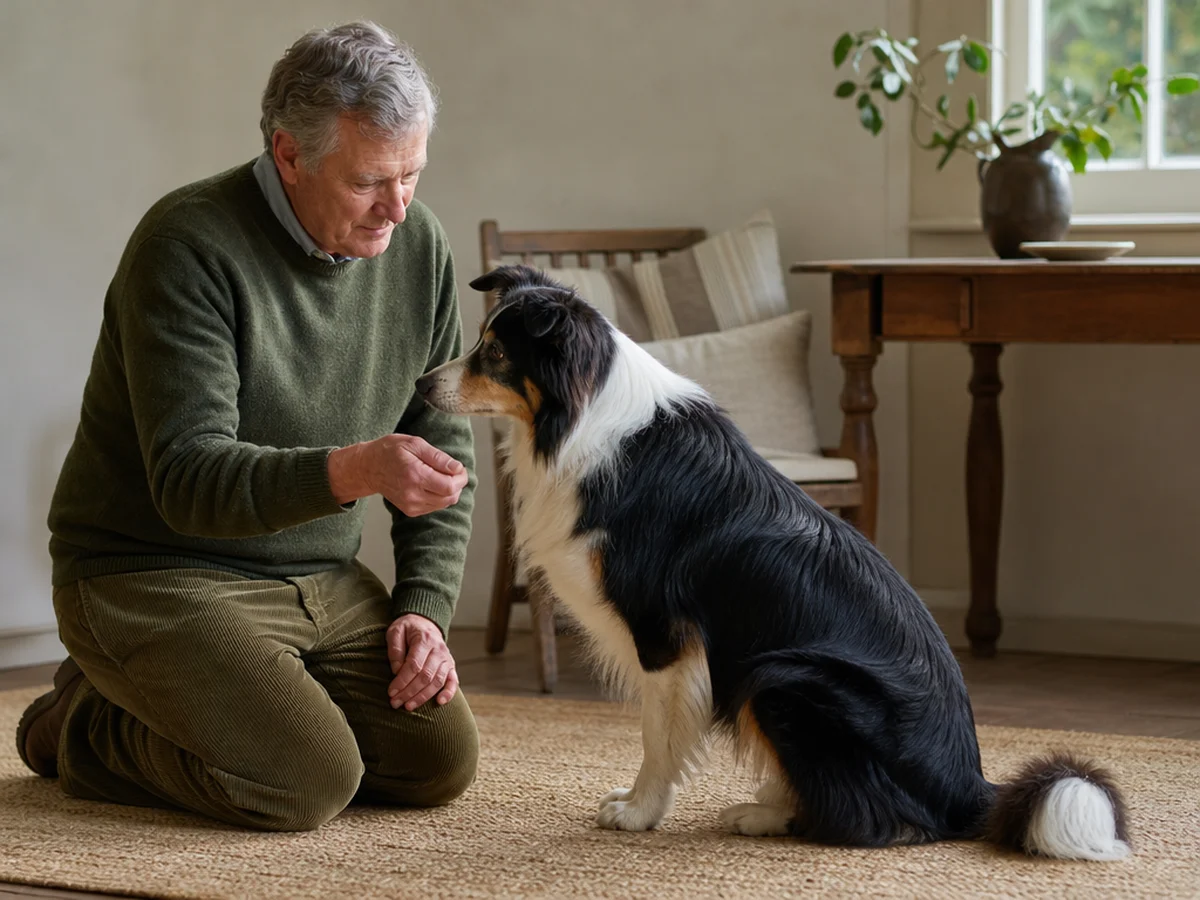
Pick two or three cues to start, such as sit, name and come, and leave the rest for later. Use a marker word, a short sound like "yes," to mark the instant you like, and follow it with a tiny piece of food. Say each cue once so the dog learns that one request is enough, and read our complete Border Collie training guide for each cue in full.
Treat every cue as new, even one the dog may have known in a past home. Mark and pay any attempt, then ask for slightly more only after three clean repetitions in a row. Keeping that rule steady is your job, and it stops you from rushing a dog who is still learning your house and your voice.
Does an adopted adult follow the puppy timeline? No. Our Border Collie puppy training timeline describes how puppies change over months, and an adult dog's early months were not yours to watch. Start from what the dog does now, and open the timeline only if a puppy shares your home too.
Why Does an Older Border Collie Ignore a Cue They Know?
Before deciding the dog is ignoring you on purpose, check three things you control: the room, the distance and the word. A cue learned in one house can fall apart in another, so ask in a quiet spot with the dog close, and give the cue once.
Stand where the dog can see you, say the cue once and pay any response. Write down which cues drew no response and in which rooms, since that note is worth bringing to your vet. If sudden sounds seem to rattle the dog too, our noise-sensitive Border Collie guide covers that work separately.
The RSPCA says older dogs may have poor hearing and eyesight, so families should avoid sudden loud noises that could startle them. If a dog appears to be ignoring you, the RSPCA says it could be because their hearing has deteriorated, and it asks owners to have the vet check them over.
The AVMA says teaching hand signals at a younger age might make it easier to communicate as hearing worsens with age. It adds that training a dog to respond to simple gestures for come or stop can let you keep control without words, and that regular veterinary examinations can detect problems in older pets before they become serious.
Pacing the Week With a New Dog
Keep sessions to a few minutes, once or twice a day, and let the dog's behavior set the next step. After a week full of change, a day with no lessons at all is a fair choice. Stop a session when any of these happens:
- The dog misses the same cue twice in a row, which tells you the request is too hard right now.
- They stop taking food, or they look away and keep looking away after you offer it.
- You hear yourself repeating a cue, since a cue said again and again gives the dog nothing new to learn.
End on one easy repeat so every session finishes with a payout, and keep the day's structure plain so the dog can guess what comes next. Meals, walks and quiet time at about the same hours give the dog less to puzzle over while they learn the rest.
What You Already Know About Your Adopted Border Collie
Taking in a dog whose early life you cannot see means starting from less than you would like to know. That says nothing against you or against them.
What you have now that you did not have on day one is a way of looking. You know the quiet checks for cues, food, touch, sudden sounds, doors and the leash. You know a missed cue is a question about the request before it is a judgment on the dog, and you know a session can stop early with nothing lost. That is a solid footing to share with a dog who is still learning your house.
 Exercise and jobsHow to Teach a Border Collie to Roll Over
 Puppy trainingBorder Collie Puppy: What to Expect and How to Start Training
 Training basicsHow to Teach a Border Collie to Lie Down