 Border Collie
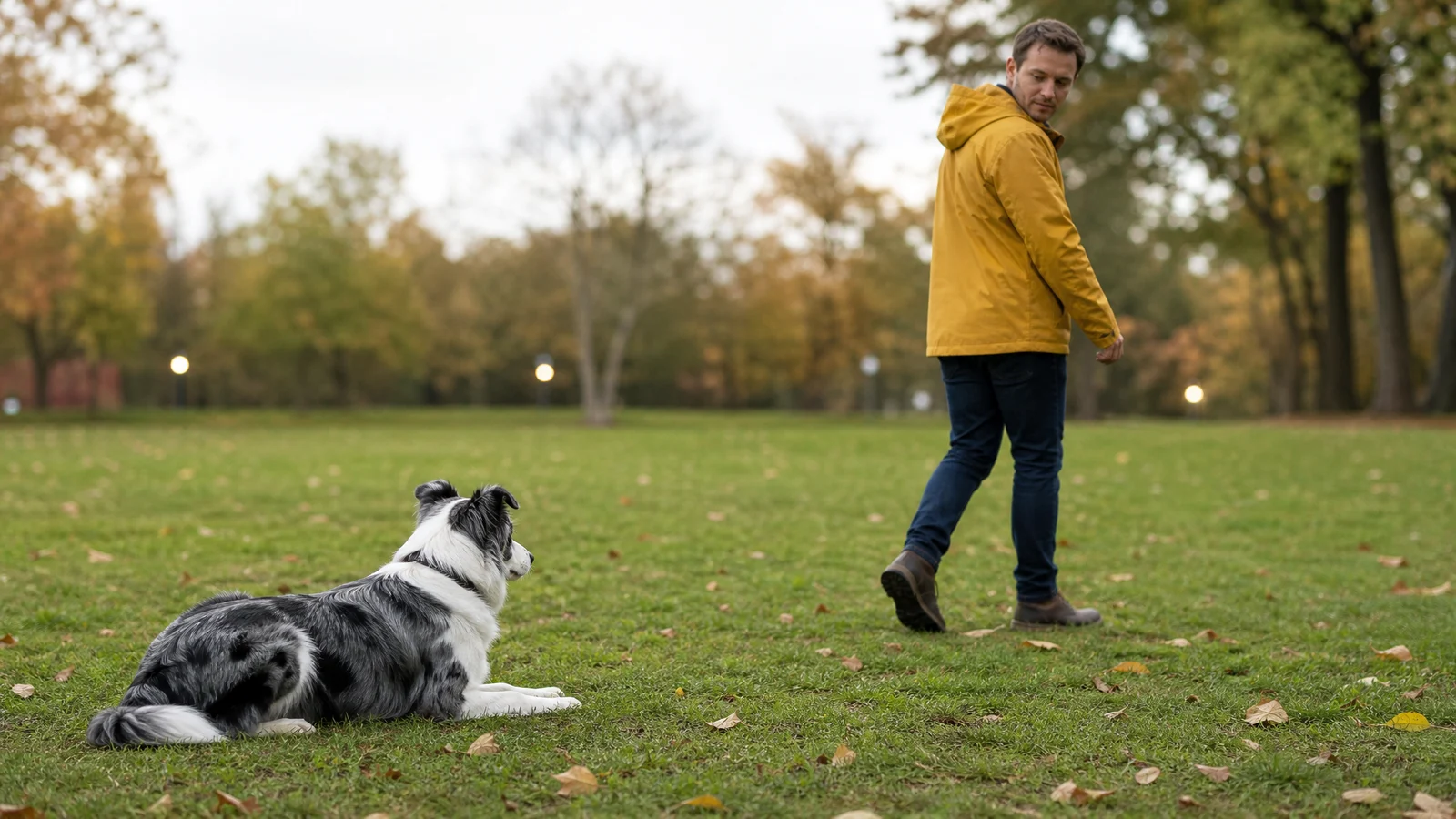
A stay can end two ways. Either you release your dog, or your dog decides it is over and moves on their own. Which of those happens shapes what your dog learns a stay means, so we treat a stay as a hold that lasts until you say it is finished. That is why the release word comes before the first hold, and why much of this lesson is about keeping that ending in your hands.
In our teaching, a stay means your dog holds one position while you move around, then waits for the word. We assume your dog already knows the position they will hold, a sit or a down, so the lesson stays on holding. This guide shows how to make the release the only way a stay ends, and how to build length once it is.
A Border Collie Stay Starts With the Release
Pick one short word that means you may move now, and choose it before you teach any hold. We like a word such as "free" or "break", used only for this and never in everyday talk.
Teach the word with no stay involved. Say it in a bright voice, then toss a treat a few feet away or hand one over so your dog moves, and let them eat it. Repeat across several short sessions until your dog turns toward you the moment they hear the word. At that point the word predicts movement, which is exactly what the end of a stay needs to predict.
Which position should the stay start in? Start with whichever one your dog already holds most comfortably on cue, and teach only that one first. A stay from a sit and a stay from a down can feel like separate lessons to a dog, so add the second position later and treat it as new.
Cornell University's veterinary college explains that adolescent puppies are often more impulsive than their adult counterparts. For an adolescent puppy who tries to dart out the door every time it opens, Cornell suggests setting up a gate to prevent access and using a leash, so the puppy cannot get outside until they can sit and wait for your release cue.
Pay Inside the Stay, Then Release
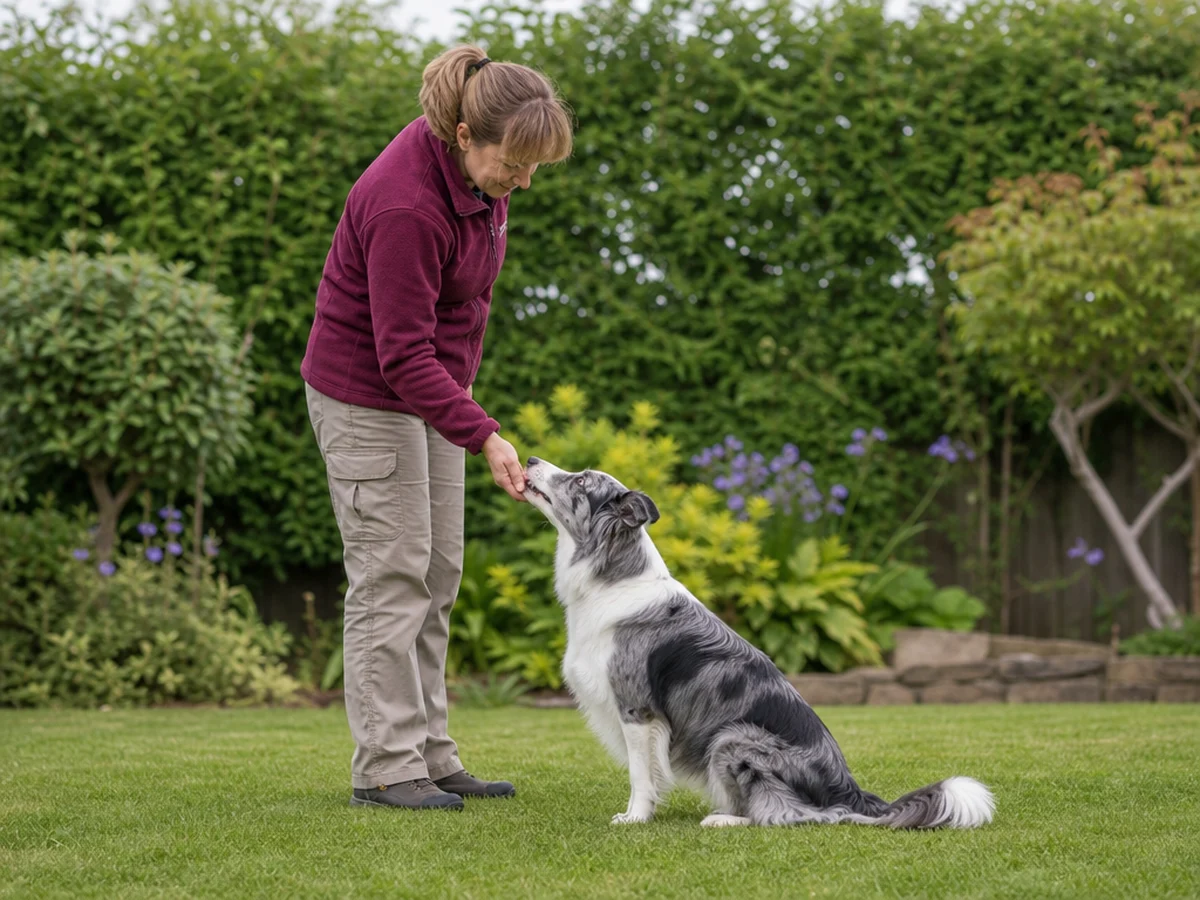
The order matters. The treat arrives while your dog is still holding the position, and the release word comes after it. A treat delivered once your dog has already moved pays for the movement instead of the hold.
Bring the treat to your dog rather than calling them to it, so they never have to leave the spot to be paid. The first holds are only a moment long, barely longer than the time it takes to ask and pay. Daily activity belongs outside these sessions, and our Border Collie exercise guide covers it.
PDSA says in its exercise advice that training should be an essential part of every dog's daily routine. It adds that training helps keep a dog's mind active and reinforces commands.
Building a Longer Border Collie Stay
Time, distance and distraction are three separate demands, and a stay is easier to build when only one of them rises at a time. Raise one, keep the other two at their easiest, and pay generously whenever you raise something.
Holding a Little Longer
Add a small pause between asking for the position and paying. If your dog moves before you pay, the pause was longer than they could manage right then, so shorten it and pay sooner on the next try. Easy successes between slightly harder ones keep a session fair. Raise the pause in small steps, and drop back to an easier length whenever the place or the day is new.
The RSPCA includes a tip about patience in its training advice: dogs all learn at different rates, so there is no need to worry if a dog does not pick things up straight away.
Stepping Away and Coming Back
Distance comes only after your dog can hold a stay for a pause with you standing right beside them. Add it in tiny pieces, using the same loop every time:
- Ask for the position and wait a moment.
- Take one step back.
- Step in again, back to your dog.
- Pay while your dog is still holding the position.
- Say the release word.
When one step is easy, try two, still returning every time. Keep your movement small and unhurried so the only thing that changes is the distance.
Should You Call the Dog Out of a Stay?
No. A stay ends when you release your dog or when you walk back to them, never with a call, because a call turns the stay into a recall. Walk back, pay in position and say the release word. Our Border Collie recall guide teaches the come cue as its own lesson.
Adding Something Interesting
Add distractions one at a time, and begin in the room where the plain stay already holds. A toy resting on the floor out of reach is an easy start, then a person walking by at a distance, then a door opening. Lower another demand when you raise a distraction, such as asking for a shorter hold while the toy sits nearby.
Humane World for Animals describes a greeting exercise for a dog who jumps on people. The dog is asked to sit and a helper approaches. If the dog stands up, the helper immediately turns and walks away, then the dog is asked to sit again and the helper approaches once more. When the dog stays seated, the helper can give a treat.
Why Does a Border Collie Stay Suddenly Break?
When a stay that held yesterday breaks today, look first at what changed in the picture, because it may be more than one thing. Two demands may have risen together, you may have moved faster or differently than before, a new smell or person may be nearby, or a long gap may have passed since the last session. If your dog is an adolescent, our teenage Border Collie training guide covers how that stage affects training.
Regular vet visits are a sensible habit for any dog. If a stay your dog used to hold suddenly seems hard for them or uncomfortable, call your vet before the next session.
Once your vet is comfortable, make the next try match the last successful one in length, place and your own movement. Pay as soon as it succeeds, and change only one thing at a time after that.
How Your Steps Shape a Border Collie Stay
Your own movement is part of every stay, because it is the one thing in the picture you control completely. Begin each try in the same stance, face your dog the same way, and keep your hands in the same place, so a change in the hold can be traced to what you added and not to how you moved.
Walk away and come back at one unhurried pace, quietly, and stop in the same spot each time before you step in to pay. As the distance grows, your steps should look the same from one try to the next, so the hold is the only thing that gets harder.
 BehaviorBorder Collie at 1 Year and Up: When Do They Calm Down?
 Training basicsAre Border Collies Easy to Train? Smart or Stubborn
 Training basicsHow to Teach a Border Collie to Focus on You