 Border Collie
Fixing separation distress means changing what leaving predicts for your dog, in steps small enough that they stay calm all the way through. Scolding has no place in it, and neither does testing how long a dog can last. The pace is slow on purpose, because each small success makes the next one possible and a rushed step costs more than it saves.
Start by finding out what really happens while you are out, since chewing or accidents do not always mean anxiety. From there we'll cover gate practice, departure cues, an absence ladder and cover for the long days you cannot train, so the whole plan sits in one place. A good deal of it happens before you ever step outside.
What Border Collie Separation Anxiety Does Out of Your Sight
Before you change anything, you need to know what happens when you leave. Guessing can send you after the wrong problem, and the right plan depends on the answer.
The American Kennel Club advises that before labeling destroyed cushions or potty accidents as separation anxiety, you should be sure it is not a case of inadequate training. It describes audio or video footage of your dog's behavior while you are away as one of the best ways to see what is really going on in your absence.
The RSPCA cites research suggesting that 8 out of 10 dogs find it hard to cope when left alone. It adds that half won't show any obvious signs, so it can be easy for owners to miss.
Setting Up a Camera
Set a phone or camera where your dog spends the time you are out and record an ordinary departure. Then write down only what you can count: how long the barking or howling runs, which rooms your dog uses, and whether a chew or treat gets touched. Chewing alone does not settle the question, and our Border Collie boredom chewing guide covers that side.
If your recordings show outside sounds setting things off, our noise-sensitive Border Collie guide covers that separate problem. Regular vet visits belong in this plan too, so book one before you start if the behavior is new, and our Border Collie vet handling guide helps those visits go smoothly.
Starting Small Behind a Stair Gate with Your Border Collie
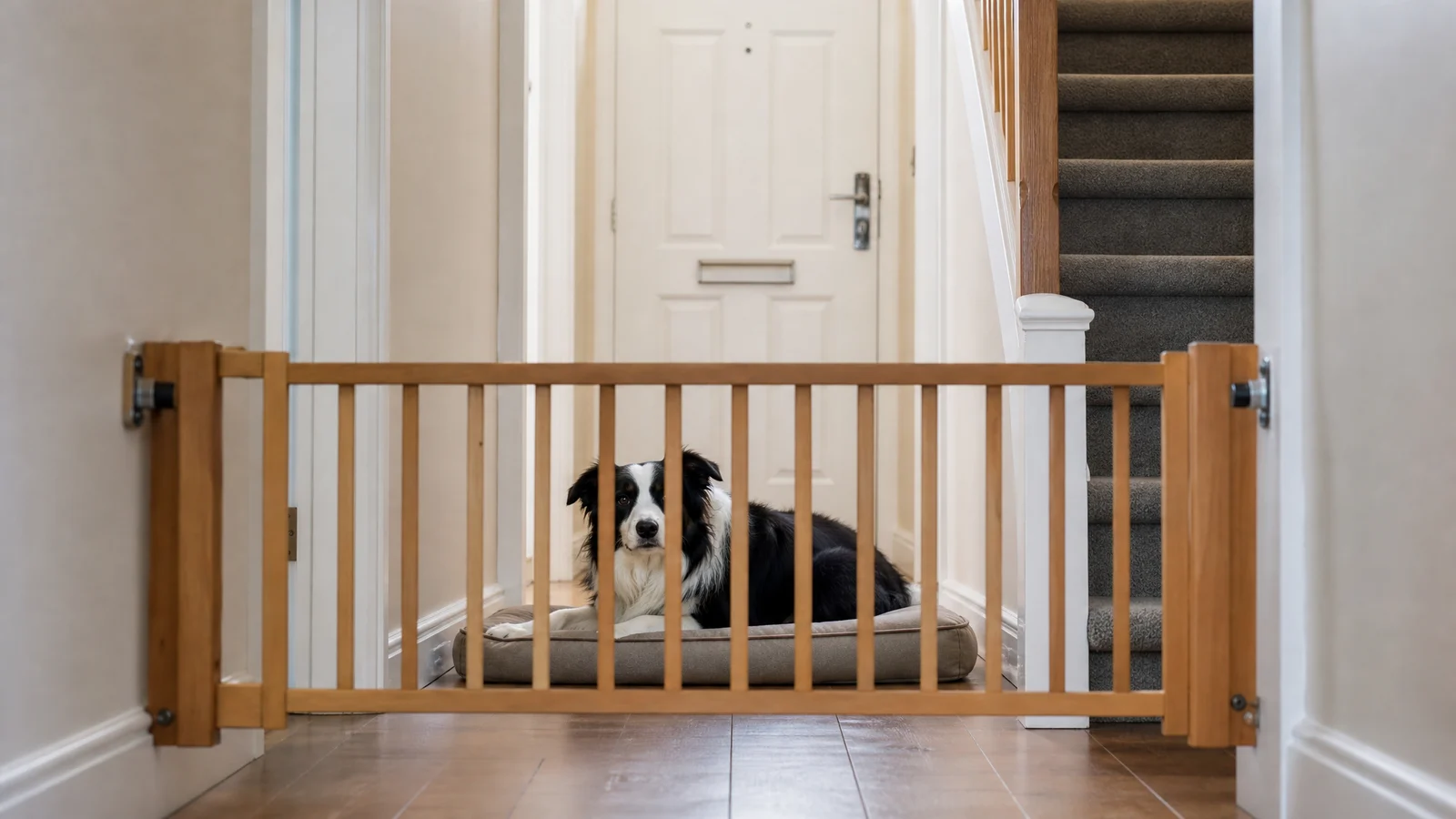
The first stage of the work happens at home, with you in the house the whole time. It gives your dog practice at being apart from you before a closing front door becomes part of it. Confinement gear and crate setup live in our Border Collie crate training guide, so this page does not repeat them.
Blue Cross says stair gates aren't as scary as a closed door because they still allow your dog to see, smell and hear you. It describes the key benefit as helping a dog get used to a little bit of distance between you while you are still in the house.
Fit a gate across the doorway of the room you would eventually leave your dog in, and put a comfortable bed in it. Close the gate, stay in sight doing something dull like folding laundry, and open it again while your dog is still relaxed. A few small treats dropped on the bed as you close it make the gate worth walking into. Finish each round early rather than stretching it past what your dog can handle.
Adding Distance and Time
Add distance and time in tiny steps over several days. First you stay in the same room, then you move to the next room with the gate still closed, then to a spot where your dog cannot see you. If a step goes badly, make the next round easier by shortening it or moving closer. If your dog finds it hard to relax on the far side, practice settling first with our guide to teaching a Border Collie to settle.
Departure Cues That Feed Border Collie Separation Anxiety
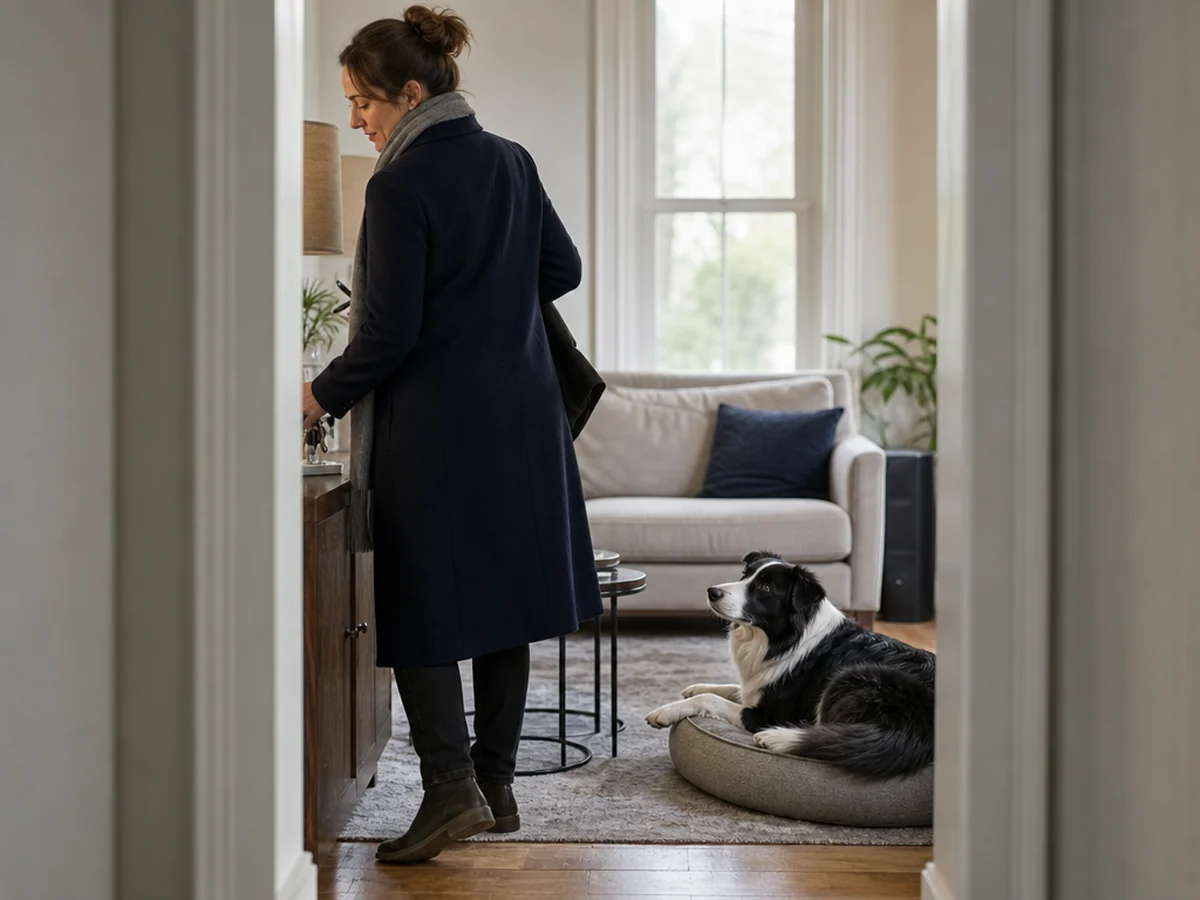
The ASPCA describes one approach for dogs who become anxious while a guardian gets ready to leave: teach your dog that when you pick up your keys or put on your coat, it doesn't always mean that you're leaving. It does this by exposing your dog to these cues in various orders several times a day, without leaving. For a dog who shows no such anxiety, it says this step can be skipped.
Walk through your own household first, because a cue is whatever your dog has learned to read, not what we expect. Common candidates include:
- Keys, a wallet or a phone being picked up from the same spot by the door each time.
- Shoes or boots going on, and a coat or bag being lifted off its hook.
- Lights, the radio or the television changing as you head out, or blinds being closed.
- Your own getting-ready sequence when it always ends with you leaving.
- The door itself, such as the handle turning, the lock clicking or the car starting.
Choose the one or two cues that seem to mean the most to your dog and shuffle them through the day with no leaving at all. Lift the keys and make tea. Put on your shoes and answer a few emails. Mix up the order and the combination so no single cue predicts a closing door. Pay calm behavior with a treat, then add one more cue only when your dog stays relaxed through the last one.
Building Border Collie Absences Below the Separation Anxiety Line
PetMD explains that the dog must remain sub-threshold during the process, meaning they haven't begun to exhibit stress behaviors in response to you leaving. It also reports trainer Tina Flores cautioning against leaving food toys with dogs who are suffering from full-blown separation anxiety.
Your recordings tell you where that line sits today. Begin every rung below it and move up only when your dog is relaxed on the rung before. This ladder starts where the gate stage ends, at the door:
- Step outside, close the door for a breath, and come straight back in.
- Stay outside the closed door for a short stretch while your dog settles inside.
- Walk to the end of the path or the hallway and return.
- Go to the car, sit for a moment, then come back inside without driving off.
- Drive away briefly and come straight back.
- Run a short errand, then lengthen errands one rung at a time.
Between rounds, wait until your dog is quiet before you go again, and keep the pause dull, with no big fuss on your return. Leave the camera running on at least some rounds so you see the rung you actually did rather than the one you meant to.
A round that goes badly means the rung was too big for today, so make the next one clearly easier and finish it while your dog is calm. If your dog keeps stalling on one rung, ask a qualified reward-based trainer or a veterinary behaviorist to look at your recordings.
Cover for the Alone Time You Cannot Train
Practice takes minutes, but most households have long days. Any absence that runs longer than the step your dog can currently manage needs someone else in it, so the cover protects what you have built.
Dogs Trust says dogs shouldn't be left alone for more than four hours anyway. It adds that if your dog is showing signs of separation anxiety, you should continue to build up to this gradually.
Line up cover before the first week of practice rather than on the morning a long day arrives. A neighbor with a key, a relative who works from home or a sitter your dog already knows can fill a gap, and one reliable person is easier on your dog than a rota that changes every week.
Whoever steps in does not need to continue the training. They only need to arrive and leave quietly, the way you do, and keep your dog comfortable until you are back.
Border Collie Separation Anxiety Questions That Stall Progress
Small decisions between rounds can matter as much as the rungs themselves. These are the ones that tend to need an answer before the next practice.
During a Round
Should you go back in if your dog cries or barks partway through a round? Set the length of each round before you start, and treat a short stretch of noise differently from distress that keeps building. If it builds, go back in calmly, greet your dog quietly and make the next round clearly shorter. Your recording will show which of the two it was.
Is it all right to slip out while your dog is dozing? Practice rounds work best when you can plan and repeat them, and a dozing dog gives you nothing to pay for and nothing to observe. A real exit that you could not avoid is simply a harder rung than the practice, so follow it with easier rounds.
Can someone else be home during a practice round? On the early rungs, yes: the gate stage and cue shuffling work fine with a quiet household around. As you move toward real absences, run more rounds with the house empty, because that is the situation the plan is preparing your dog for.
Judging Progress
How do you tell whether things are improving from one recording to the next? Compare like with like: the same rung, a similar time of day and the same length. Look at how quickly your dog settles and how long any noise lasts against last week's clip of that rung. One rough clip among several easy ones is not a reversal, but a run of harder clips means dropping a rung.
Is it worth using a camera that lets you talk to your dog? The recording is the useful part. If your camera has a speaker, try it on a rung your dog already handles well, and compare that clip with a silent one of the same rung. Treat your voice as one more variable, and drop it if the clips look no easier.
Around the Household
What if the distress only shows when one particular person leaves? Record that person's departures separately from everyone else's and note what they do on the way out that others do not. They can then run the early rungs, the gate and the cue shuffling, while the rest of the household keeps its routine unchanged. A trainer can watch the footage and suggest what to try next.
Does everyone in the house need to say goodbye the same way? For departures, as far as you can manage it, yes. Everyone who leaves should use the same quiet routine, with no long farewells and a low-key hello on return. Children can follow a short version of the same rule: no drama at the door.
What should you say to a neighbor who has complained? Keep it short, kind and truthful: you know the noise is a problem, you are working through a plan, and it should improve gradually rather than overnight. Share a way to reach you, and ask them to tell you when the noise happens so you can match it against your recordings. Promise no dates.
Quiet Doors and What Sets a Border Collie Back
By this stage the plan is mostly habit, and the door is where the habit lives. Leave without a farewell speech, skip the urge to apologize to your dog, and shrink your goodbye until it is nearly invisible. Your dog has watched you leave many times, and a quiet, predictable exit gives them less to react to than a warm, drawn-out one. A rough patch, if one comes, gets the same answer as everything else here: an easier rung and the same calm door.
Humane World for Animals quotes one expert as saying to leave at the same time and come home at the same time, and another as saying to keep your departures and your return home as chill as possible. It adds that behaviors tied to separation anxiety may resurface during other times of transition.
The routine that lasts is the plain one: keys lifted without hurry, the door closed gently and a quiet hello when you return, whatever state the house is in. Repeat it the same way on ordinary days, including the ones when nothing is being practiced, so the door never turns into an event.
 Puppy trainingBorder Collie Puppy at 3 to 4 Months: Teething and Mouthing
 Exercise and jobsEasy Tricks to Teach a Border Collie
 Exercise and jobsHow to Teach a Border Collie to Spin