 Border Collie
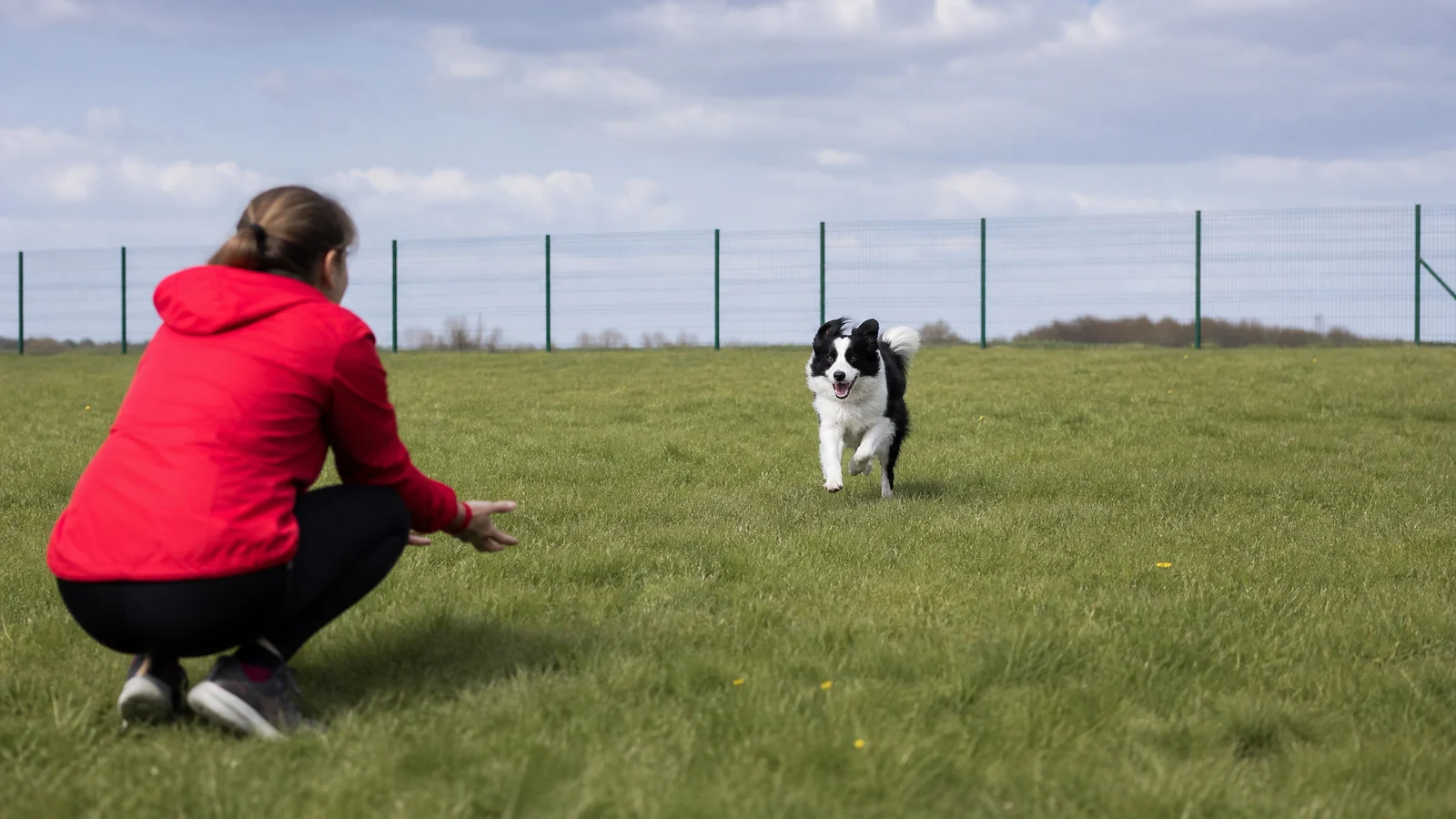
Common wisdom says a tired dog is a calm one, and for plenty of breeds a long run delivers exactly that. A Border Collie only gets fitter. Endurance is this breed's trademark, and the standard describes a gait that is free, smooth and tireless, so every lap builds a stronger dog who wants another. That changes the order of things: reliable recall has to be taught before any running is added.
Handled badly, running produces a very fast dog who has learned that leaving beats returning. Done right, it gives you a dog who sprints, turns and flies, then comes back to you with the same joy. Below, you'll find a hypothetical puppy followed from the hallway out to open ground, including a first recall cue, fetch-style sprints, long-line distance work, a weekly running routine, and fixes for stalking and circling.
Border Collie Puppy Example Setup
Our example is hypothetical and exists only to show the order of the steps. The puppy has just turned ten weeks old. Home is an apartment with two bedrooms, a hallway long enough for a short dash, and a quiet park nearby. The owner works a normal day and has the evenings free. Swap in your own space and schedule, but keep the sequence.
That sequence is recall first, speed second, open ground last. This puppy already has the quick pivots the standard describes, since good body balance lets the breed change direction and speed in an instant. The plan channels that agility instead of fighting it. We have trained Border Collies for many years, and this order is the one that keeps fast dogs safe.
Set these starting rules on day one and keep them until the last section tells you they have been earned. Relax only one rule at a time.
- Teach the recall word before any running game, and pay for every response so the word never goes stale.
- Keep every unfenced outing on a long line until the puppy comes reliably from a distance.
- Make the return the most rewarding moment of any game, never the moment the fun stops.
- Pair each running session with mental work, because speed builds stamina and little else.
- Book regular vet visits so growth, joints and fitness are checked by someone who can see your puppy.
The fourth rule matters most. This is a high-drive, athletic breed that needs daily exercise well beyond a walk around the block or a quick romp in the yard, so the temptation is to close the gap with more miles. Resist it. Plan daily structured mental and physical work, and let running be one piece of that day.
Recall Basics Indoors
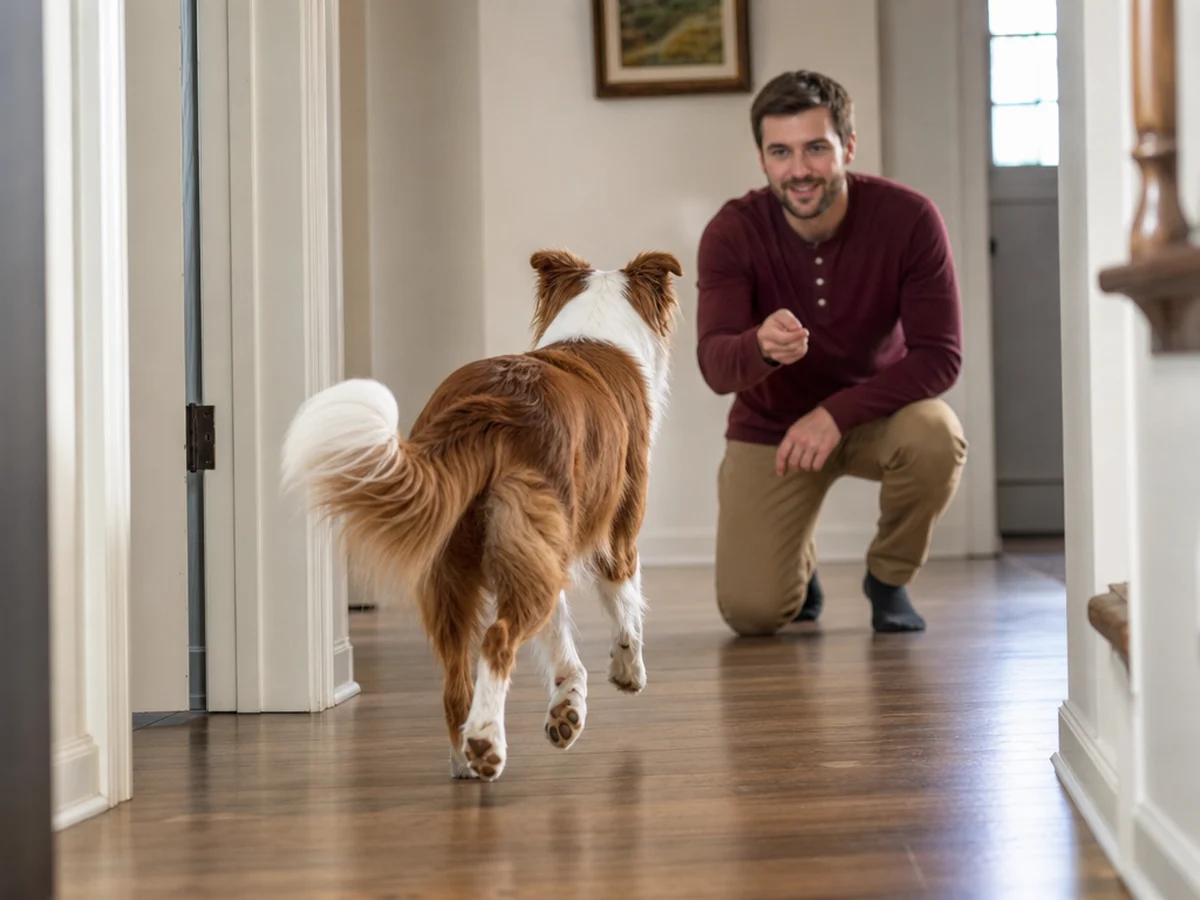
Your hallway and living room are the best classroom you have, because nothing in them competes with you. A Border Collie puppy watches your hands, feet and eyes all day, and the standard calls the breed keen and responsive. You are teaching a dog who already wants to engage. Attach a word to something they like doing anyway, which is coming to you for something good, and end each session before the puppy's interest fades.
Choose the Cue
Choose a single word and reserve it for recall alone. Speak it one time in a bright voice, when the puppy stands a few paces off and is already looking your way. Repeating it teaches them that the first one doesn't count. Keep the word away from anything unwelcome, like starting a nail trim, or it loses its pull. Everyone in the apartment must use the same word.
Reward at Your Knees
When the puppy arrives, deliver a small soft treat right at your knees, then add praise. Paying close to your body teaches them that the finish line is you, not a hover just out of reach. Give a jackpot of several treats for the best recalls, such as coming from the bedroom or turning away from a toy. Add a quick game of tug as a second reward if your puppy enjoys it.
Release With a Word
Teach a release word, then let the puppy go back to whatever they were doing. This is the quiet secret of a dependable Border Collie recall. When every return to you means the fun is over, a clever dog works out the pattern fast and starts staying away. When coming to you is a brief pit stop on the way back to the fun, they return again and again.
Release them, and play on. Then reset for another short repetition.
Sprint Games for Recall
Fetch-style sprints are the best way to turn the breed's speed into a rewarded return. The standard credits the Border Collie with the balance to move from a high speed to a creep and to change direction in a heartbeat. Your game should use that, so build turns into it instead of running straight lines. In the example, the puppy starts with a toy in the hallway and later takes the same game outdoors on a long line.
Design the Sprint
Keep each run short and change its shape. Roll the toy along the floor, then toss it to one side, then the other, so the puppy practices sharp turns instead of flat-out speed. Ask for a sit before you release them to chase, which builds a pause into the excitement. A Border Collie who learns to wait at the edge of a sprint is far easier to call back than one who knows only full throttle.
Vary the surface as the puppy grows, but start on grippy flooring or grass. Slick floors turn sudden stops into slips, and this breed stops suddenly.
Make the Finish Count
The sprint is only half the game. Call your recall word as the puppy grabs the toy, then step backward to invite them in. When they arrive, trade the toy for a treat, add praise, and start another run. A calm sit at your feet before each throw teaches that every run ends with a return. If the puppy runs off with the toy, don't chase. Walk away, and let them follow.
Recall Distance Outdoors
Now follow the same puppy to a quiet outdoor space, such as an empty corner of the park. Every skill from the hallway gets harder here, because the world is full of movement, smells and sound. Treat the park as a brand-new classroom and drop your expectations back to the start. Before any off-leash time in a public place, a dog needs a strong, reliable recall, and a Border Collie is no exception.
Work the Long Line
Clip a lightweight long line to a well-fitted harness and let it trail. The line gives the puppy the feeling of freedom while keeping the outcome safe. Call from a short distance, reward at your knees, and release. Keep your handling consistent from one session to the next, because a long line that is sometimes loose and sometimes tight sends mixed messages.
Lengthen the distance in small steps, and only after several successful recalls at the current distance. If the puppy misses the cue, shorten the gap and try again. Dropping back a level is not a failure. It is how the cue stays solid.
Add Distractions Gradually
Introduce one distraction at a time, beginning at a distance where success is still easy for the puppy. A distant jogger, a bouncing ball in another yard or a passing bicycle can trigger the breed's chase instinct, since these dogs are naturally drawn to chasing and controlling movement. Reward heavily for any turn toward you, then work closer. For more on that urge around moving things, see our guide to Border Collie recall near sheep and open fields.
Proof the Cue
Proofing means practicing the same recall in many places, at different times, with different rewards, and with you in different positions. Call from behind a tree, while sitting, or while facing away. Vary what waits at your knees so the puppy never knows whether it's food, a toy or a sprint. Only when the cue holds across all of these, on the long line, should you consider a fenced space for loose running.
A Border Collie Running Routine
Running belongs in a weekly pattern, and the pattern changes as your dog grows. The goal is not to wear them out, since endurance is the breed's trademark. The goal is to give a structured outlet, then switch to rest and brain work, so your Border Collie learns that excitement has an off switch. The table shows how the example puppy's week evolves.
| Stage | Running | Mental work and rest |
|---|---|---|
| Ten weeks | Short hallway sprints and a few long-line recalls | Recall games, settling on a mat, long naps |
| Later puppyhood | Brief sprints with turns, long-line outings | Socialization trips, scent games, rest days |
| Adolescence | Longer sprint sessions, still on a line in open areas | Training reviews, puzzle work, calm time |
| Adult | Regular running mixed with sports | Daily structured work, rest days built in |
Raise the amount slowly and ask your vet at regular visits what suits a growing dog. Endurance is the breed's trademark, so you set the limit. Build full rest days into the week and end sessions while the puppy still wants more. A dog who cannot stop is not fit, they are wound up.
Balance every running day with mental work. Scent games are ideal. To start nose work with open boxes, bait some of them with smelly treats so your dog finds them and rewards themselves. A herding ball or low-jump agility suits an older dog. These fill the working-dog gap that running alone never will.
Recall Problems in Border Collies
Even a well-planned puppy hits snags, and the snags tend to look like the breed. Border Collies were shaped to move stock with eye, creep and stalk, so what you see in the park is rarely disobedience. It is working behavior showing up in the wrong place. Each fix below stays reward-based and keeps your dog successful.
Stalking and Fixating
When the puppy locks onto a jogger or another dog and starts to creep, the stare is the trigger, so step in before it builds. Call on the first head turn toward the distraction, reward the moment they look back, and move away. If the stare is already deep, add distance and run a toy sprint in the opposite direction to break it. Over time, pay for every voluntary glance at you. Fixation fades when checking in becomes more profitable than staring.
Circling and Herding You
Some Border Collies run wide circles around you instead of coming in, or nip at heels and cut off your path. That is herding, and the cure is to give them something else to do at the finish. Stand still, turn your side to them, and ask for a hand touch or a sit when they arrive. Reward at your knees. Don't grab or reach, which turns the return into a game of chase. If the circling continues, end the session and try again with less excitement.
Hovering Out of Reach
Some dogs return close but stop just beyond arm's length and dance away if you reach. Pay them where they stand at first, then ask for one step closer before the treat arrives. Touch the harness only occasionally, pair it with a treat, and release right away. If recall worsens suddenly without an obvious cause, think health. A sudden behavior change in an adult can be one of the earliest signs of pain or illness.
Recall First, Then Free Running
Free running is the reward at the end of this plan, never the start of it. Walk the example puppy through three checkpoints that show the plan is holding:
- They respond to the cue the first time, in a distracting outdoor space, on the long line.
- They return and settle at your knees without circling or hovering.
- They leave a toy, a stare or a moving target when called, and are rewarded for it.
When all three hold in several different places, try a fenced area before any open ground. Keep the rewards coming even then, because a recall that stops paying fades.
Some stalls call for outside eyes. If recall slows over a few weeks, if fixation on movement deepens despite the steps above, or if your dog turns lame or reluctant to run, pause the running and ask for help. A trainer who works with rewards can untangle a stuck recall or intense fixation, and your vet should look at any sudden lameness.
A Border Collie will always be willing and able to run farther and faster than you can follow, and that is exactly why the order matters. Build the cue indoors, pay for the return every time, keep the running short and varied, and back every sprint with mental work. A dog who loves to run and loves to come back to you is the goal, and teaching recall first is what gets you there.
 Puppy trainingBorder Collie Puppy Milestones From 8 Weeks to 2 Years
 BehaviorRedirecting a Border Collie Who Nips Ankles and Herds Kids
 BehaviorBorder Collie Food Aggression: Teaching a Trade Instead