 Border Collie
Timing is the question owners ask first, so here it is plainly. Whether your Border Collie is a puppy still inside the socialization window of about seven months or a settled adult, plan on keeping them completely separate from your resident cat or poultry for at least two to three weeks, with careful introductions only after that. The cat who has ruled your home for years can wait, and your dog needs that time more.
This matters because Border Collies were bred to gather and control moving animals, so a running cat or a scattering flock can turn into stock overnight. Handled badly, that means a frightened cat, an injured bird, or a dog who rehearses the chase every day. Handled well, you get a dog who glances at the animals and checks back with you.
We have trained this breed for many years, so the steps below follow the order that works. Read on for the household check, daily management, the instinct behind the chase, the core skills, the first leashed meeting, and a two-week schedule.
Household and Livestock Before Training
Start with the widest view: who lives in the home or on the property, which animals are at stake, and what your doors, fences, and rooms can physically do. A Border Collie's instinct does not sort pets from livestock, so every species needs its own plan. A dog who stays calm around the family cat may treat a flock of hens very differently, and the reverse is just as possible.
Cats
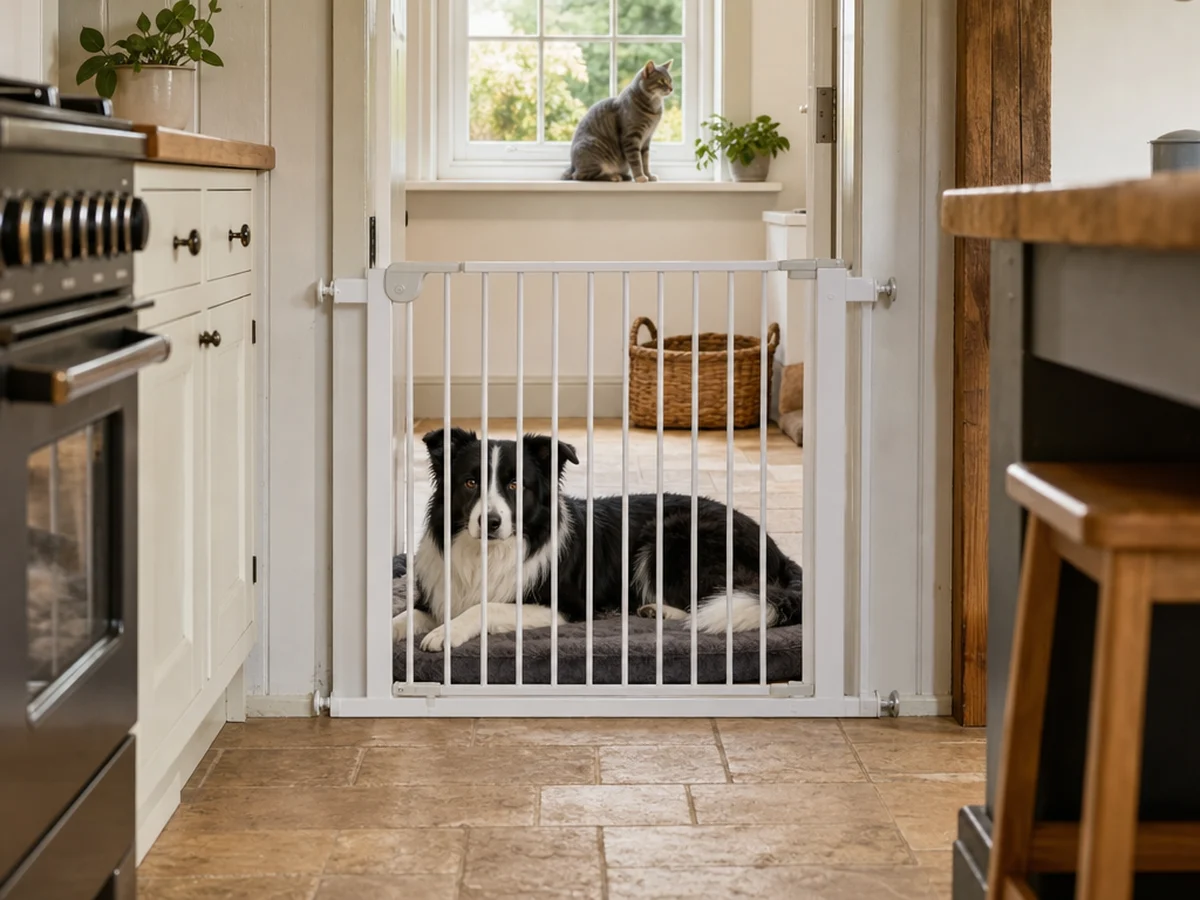
Cats run, and running is the signal that switches herding on. Your first job is to hand the cat control. Set aside a room with food, water, litter, and a high perch, behind a door your dog cannot open. In shared rooms, add shelves or cat trees so the cat can climb out of reach and watch from above.
A cat with an exit stays confident, and a confident cat who sits still is far less exciting to a herding dog than one who bolts. Keep that route open during every session.
Poultry
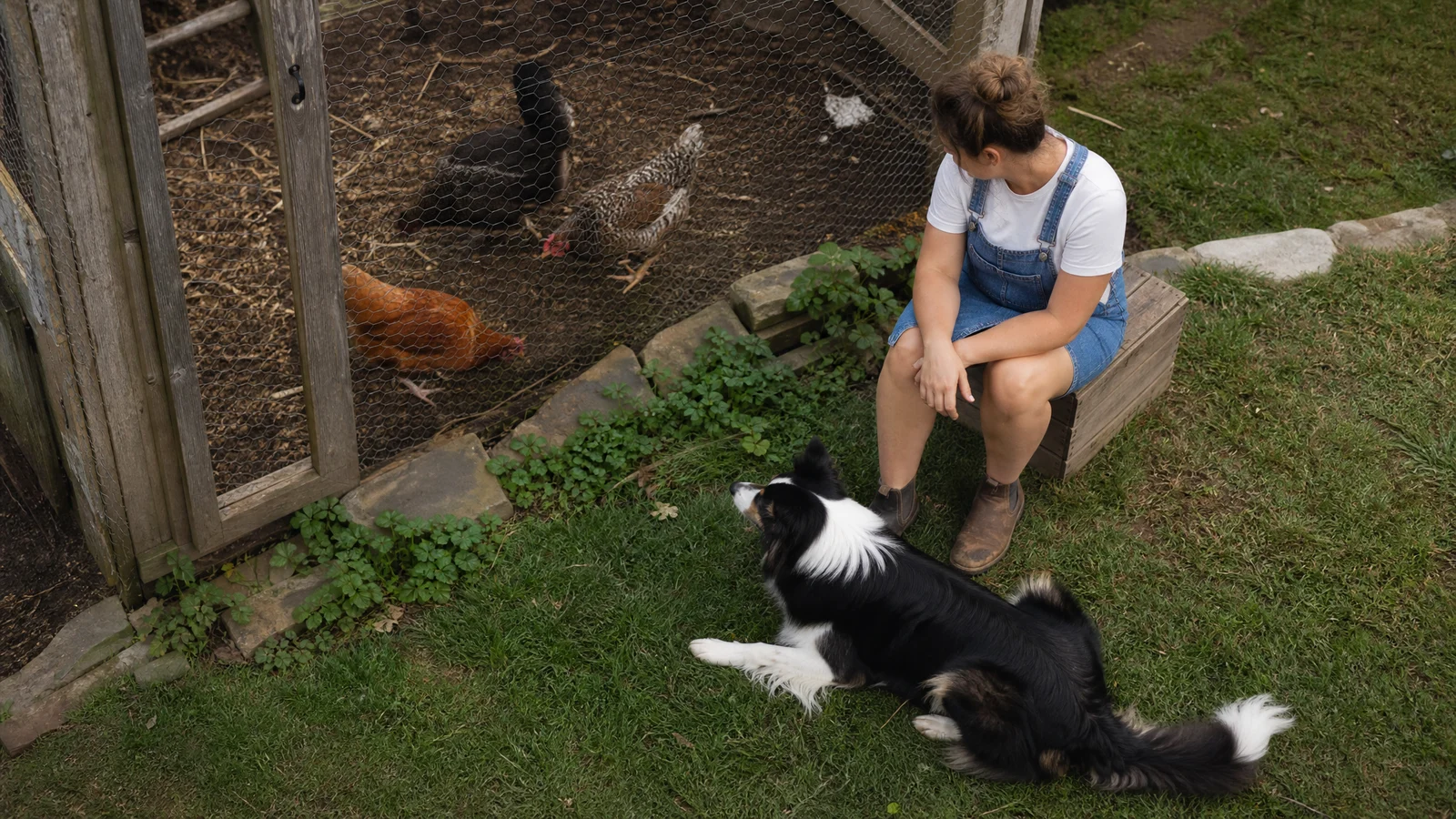
Poultry is the hardest case, because flapping and scattering are exactly what a gathering dog loves to work. Hens need a fully enclosed, roofed run with a secure latch and fencing your dog cannot reach through or jump.
Even a dog who never bites can press birds into a corner until they are exhausted or hurt, so treat any contact as unsafe. Let the birds out only when your dog is indoors or behind a solid barrier.
Goats and Ducks
Goats and ducks fall in between. Ducks move as a bunch, which is the kind of movement this breed was built to direct. Goats may stand their ground, and a dog who presses in can take a kick or a butt. Use a double-gate entry so your dog can never slip through while your hands are full of feed.
Away From Home
The stakes rise on other people's land. Under UK countryside rules, farmers may legally shoot dogs who chase or attack their animals. That makes a leash the safest choice around anyone's stock, however well your dog listens in the yard.
Daily Management and Training Routine
Management is the quiet half of training. Every rehearsal of stalking the cat strengthens the habit, so daily life should block rehearsals while your skills build. Work in zones: when your dog is in one, the animals are in another, with a solid door or pen between them. Here is a typical day, in order.
Mornings
Exercise comes first. This is a high-drive, athletic breed that needs daily exercise beyond a walk around the block, and a dog who has run and used their brain is far easier to manage once the animals come out. Mix movement with thinking work, because a bright workaholic tires mentally as much as physically.
Next, settle your dog in their zone with a chew or a food puzzle. Only then do you feed the cat or open the coop. Reverse that order and your dog spends the whole morning wound up behind a door.
Midday and Afternoons
This is calm-reward time. Sit with your dog on a leash at a distance where they can see the cat or hens through a window, gate, or pen, and reward every glance away. If barking starts, our guide to teaching a Border Collie to settle covers the next step.
Keep sessions brief and quit on a win. Between sessions, cover the window or close the door so your dog is not practicing a long stare alone.
Evenings and Nights
Evenings are when energy spills over, and when cats often get active. Once the workday is done, these dogs settle down for cuddle time, so build that into the routine: a last outing, a chew, then your dog's own spot.
At night, shut the coop at dusk, close the cat's room, and put your dog in a crate or a room behind a closed door. Unsupervised time together is off the table, even for a minute, until you have a long record of calm behind you.
Everyday Training Around Cats and Poultry
A Border Collie who shares space with a cat or poultry is rehearsing something every hour of the day, so good management does as much training as your treat pouch. The goal is to arrange the day so the chase never gets practiced and calm behavior gets paid. Think in terms of barriers, schedules, and separate zones, and match each to the time of day.
Before Breakfast
Start the day with your dog's exercise and a meal in a quiet spot, before the cat is up and moving. Keep the cat's food and litter box in a room your dog cannot enter, using a baby gate the cat can hop over or a door latched open just wide enough for the cat. Check that the coop or run is latched before your dog goes into the yard.
During the Workday
If no one is home, your dog should be in a space the animals cannot reach, with a puzzle toy or chew to keep a busy mind occupied. A bored, under-exercised dog is far more likely to fixate on anything that moves. When you are home, use short sessions in which your dog sees the cat through a gate and earns treats for looking away.
After Dinner
Evenings are when energy spills over and cats tend to wake up. Offer a trick session or a game of fetch first so your dog has real work to do, then settle them on a mat or in a crate while the cat roams. Shut poultry in for the night, and keep your dog on a leash outdoors until you have checked that the yard is clear.
Why a Border Collie Chases Stock
To train this dog well, you need to know what drives them. Border Collies herd because their bodies and minds were crafted for the task, and they are naturally drawn to chasing and controlling the movement of animals. The breed came from the Border country between Scotland and England, where shepherds bred for stock sense and the ability to work long days.
The working style is specific. Dogs gather and fetch stock with wide sweeping outruns, then control it with an intense gaze called "eye" and a stalking style of movement. Put a bolting cat into that sequence and you can see how fast a living room becomes a field.
The chase is more likely driven by herding focus than by aggression. A breed built to control moving animals will tend to lock on to anything that bolts or scatters, and the urge to gather it can come with real frustration when they are blocked. The breed is also prized for working out of sight of their handler without commands, so a dog who looks obedient while you watch may choose differently when you step out of the room.
You will hear advice to let the dog herd the chickens a little so the instinct burns off. We disagree. Practice strengthens the pattern, and the birds pay for it. Give the drive a real job elsewhere.
Signs the Herding Sequence Has Started
Watch for these early signs that your dog has switched into stock mode. Notice them before the chase begins.
- A fixed, unblinking stare at the cat or birds, which is the start of eye.
- A lowered head and shoulders, or a freeze mid-step.
- Slow, deliberate stalking steps in place of a relaxed walk.
- An attempt to circle wide around the animal, as in an outrun.
- Deafness to your voice and your treats while the animals move.
For what to reward instead, see our guide to Border Collie stare and stalk. The same drive is why Border Collies tend to herd animals and people, so children running past can set it off too.
Border Collie Training Basics
Training means teaching your dog what to do instead, and every skill here runs on treats, praise, and play. The best available evidence favors reward-based methods only across all dog training, behavior problems included. Teach the skills in this order, and practice each one away from the animals before you add them.
Reward Calm Looks Away
This is the foundation. Choose a spot far enough from the cat or birds that your dog notices them but can still think. The moment your dog looks away, say your marker word, then deliver a treat at your side so they turn toward you.
Reward the glance away, never the stare. As this gets easy, move closer in small steps. A locked gaze means the distance is too short, so back up and start again.
Leash Use Near Animals
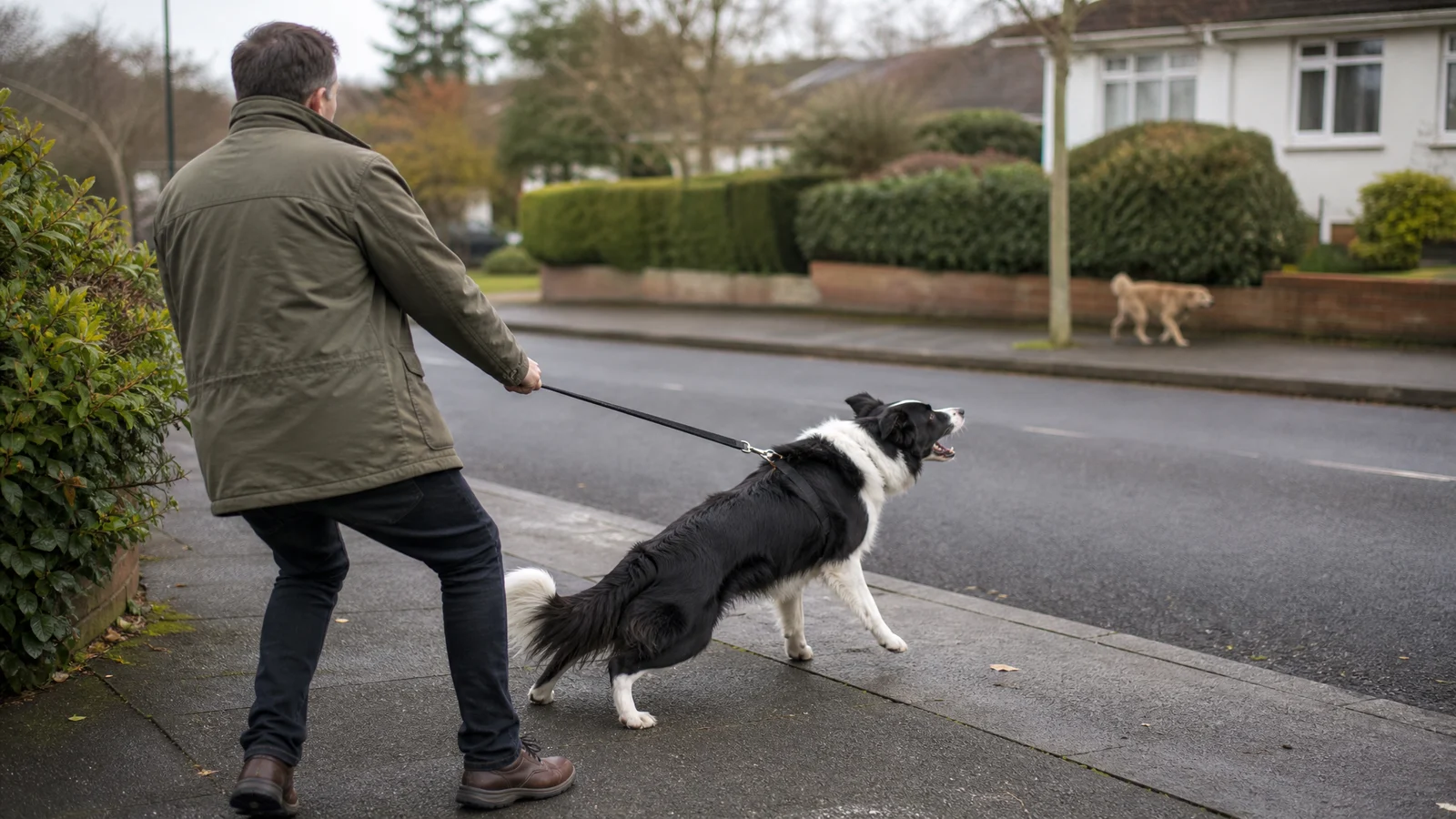
Use a leash and a well-fitted harness any time animals are loose. Pay your dog for staying at your side on a slack leash, and walk away from the animals the moment tension builds, rewarding as soon as they follow.
The leash is a safety line, not a steering wheel. Keep it slack and use your feet and your treats to turn the dog.
A Leave Cue
Start with a treat in a closed hand. When your dog backs off from sniffing it, mark and reward from your other hand. Add the word once the behavior is reliable.
Next, use a toy on the floor, then something that moves, and finally the animals at a distance. The cue means "turn away from that and collect your reward from your handler," which suits a dog who loves having a job.
Recall Near Animals
A recall is your emergency brake. Teach it in quiet rooms, then the yard, then with the animals far away behind a barrier, and pay with the best treats every time. Do not call your dog away from the animals until they come eagerly in easy settings.
For bigger spaces, see our guide to Border Collie recall near sheep and open fields. Keep a long line attached until the cue is automatic, and remember that a good yard recall does not make off-leash time near livestock safe.
Training the First Leashed Introduction
The first meeting comes only after the separation period and weeks of calm-reward work. Rescue guidance puts the minimum separation for a newly arrived dog and a resident cat at at least two to three weeks, and only then careful introductions. We treat that as a floor for a breed with this much eye. Then follow these steps, reading your dog's body at each one.
- Prepare the room so the cat has a high perch and an open exit, your dog wears a harness and leash, treats are in your pocket, and your dog has already had a good workout.
- Start with your dog across the room and the cat in view. A loose, wiggly body, soft eyes, floor sniffing, and glances away are good signs, so mark and reward them.
- If your dog stiffens, freezes, lowers their head, or stares, eye is starting. Step back or turn away, ask for the leave cue, and reward the moment they disengage.
- Watch the cat as closely as the dog. Flattened ears, a puffed tail, hissing, or crouching mean it is too much, so open the exit and end the session.
- If your dog stays loose and curious, you may shorten the distance a little with the leash slack and treats flowing. The cat decides whether to come closer, never you.
- Finish while everything is still calm, then separate them again and give your dog a chew in their own zone.
Never drop the leash during early meetings. Progress looks boring: a yawn, a sniff of the floor, a dog who glances at the cat and looks back at you. Boring is the goal.
Reading Border Collie Body Language During Cat Introductions
The first leashed meeting is short, and what matters most is what your dog's body tells you from one moment to the next. Work in a room you have prepared, with your dog on a harness and leash and the cat free to leave. Each step below pairs what you do with what you want to see, and the body language decides whether you move forward or back up.
- Start with your dog across the room, facing you. Look for a loose body, soft eyes, and a wiggle. Reward any glance at the cat that ends with a look back at you.
- If your dog's body goes still, the head drops, or the stare locks, they have switched into working mode. Add distance right away and pay for the first turn of the head.
- Move a few steps closer only while the muscles stay relaxed and the mouth is soft. A stalking crouch or a raised paw means you are too near, so retreat and begin again.
- Watch the cat as well. Flattened ears, a puffed tail, or hiding mean the session ends there, and the cat's exit stays open throughout.
- End on a calm moment, not a perfect one. Walk your dog out, give a treat and praise, and repeat the session on another day.
A Border Collie Coexistence Training Plan
Here is everything above as one schedule for the next two weeks. The barriers go up on the first day, which also starts the separation clock. If your dog joined the household recently, run the plan as written but push the leashed meeting into the third week. If you see a stop signal, drop back a stage the next day.
| Stage | What you do | Stop signal |
|---|---|---|
| First days | Set up solid barriers and separate zones, give the cat perches, and exercise your dog before the animals' routines. | Your dog stares at the barrier, whines, or paces for long stretches. |
| Rest of the first week | Run short calm-reward sessions through a gate or window from far away, rewarding every look away. | A fixed stare, freezing, or a lowered head. |
| Start of the second week | Add the leave cue, leash practice, and distant recall with the animals visible but far off. | Your dog ignores the cue or turns down treats. |
| Middle of the second week | Close the distance in small steps while the animals move calmly, still rewarding calm. | Stalking steps, or the cat hiding or puffing up. |
| End of the second week | Hold one short leashed meeting using the steps above, then separate again. | A stiff body, fixed eye, or hissing, so end calmly and step back a stage. |
Barriers alone will not carry this plan, because a Border Collie is a high-drive dog who needs real exercise and a job, and a dog without one will find stock in the cat and the hens.
Give the drive an outlet through rally, disc dog, obedience, or agility, and keep up regular vet visits so any change in how your dog reacts to the animals gets checked early. These dogs settle beautifully once the workday is done, so give them the workday and the calm around cats and farm animals follows.
 Training basicsHow to Teach a Border Collie Recall Near Sheep and Open Fields
 Puppy trainingKeeping a Teenage Border Collie's Training on Track as Drive Grows
 BehaviorBorder Collie Leash Reactivity: What Helps